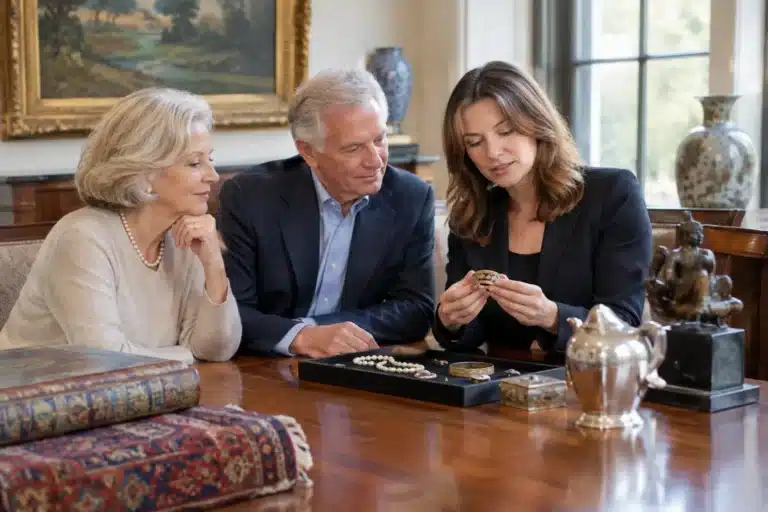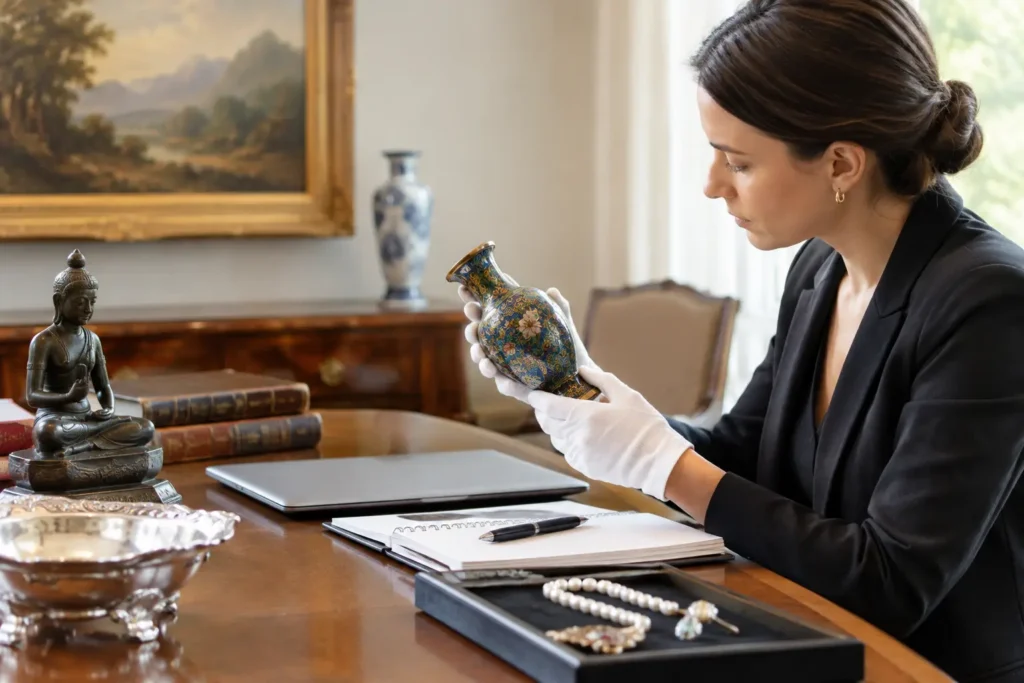
A collection can look like a room full of unrelated objects when you first inherit it: paintings stacked behind a door, silver in a sideboard, coins in envelopes, family jewelry in a drawer, or decades of records, books, and memorabilia. Knowing how to catalog inherited collections gives you a clear record of what is present before items are moved, divided, insured, donated, or offered for sale. It also protects against a common estate mistake: treating an object as ordinary before anyone has identified it properly.
Start by preserving context, not assigning value
The first task is not to price every object. It is to preserve information that may disappear once a home is cleared or a collection is separated. Leave items where they are long enough to photograph shelves, display cases, boxes, labels, and groups as found. A handwritten tag, old auction catalog, receipt, or note in a relative’s handwriting may help establish maker, age, ownership history, or the way a collection was assembled.
Work slowly with fragile material. Do not polish sterling silver, clean coins, remove old labels, replace picture frames, or attempt repairs before documentation. A brightened silver service or a cleaned coin may look more presentable, but the work can reduce collector interest or obscure useful evidence. Likewise, old furniture should not be refinished simply because its surface looks worn. Original finishes, hardware, and even honest wear can matter.
If the collection is in a home that must be sold quickly, photograph first and move second. Clear access routes and address obvious safety concerns, but avoid broad disposal decisions until the contents have been reviewed.
Create one workable inventory
A useful catalog does not need to begin as a formal appraisal report. A spreadsheet, notebook, or inventory application is sufficient if the entries are consistent. Assign every object or grouped lot a unique inventory number, such as ART-001 or COIN-014. Place a removable tag near the object when appropriate, rather than applying adhesive directly to it.
For each entry, record the same basic details:
- Inventory number and category
- Brief description, including maker’s marks, signatures, inscriptions, or labels
- Dimensions, material, and quantity
- Condition observations and any visible damage or alterations
- Where the item was found and any known family history
- Photograph file names and the location of related paperwork
Descriptions should be factual rather than speculative. “Oil painting, signed lower right ‘J. Smith,’ 24 by 36 inches, framed” is more useful than “valuable old painting.” If a signature is difficult to read, photograph it closely and write exactly what appears visible. Avoid identifying an artist, period, or material unless you are certain. A mistaken identification can spread through estate records and create confusion later.
Catalog groups before individual pieces when necessary
Not every inherited item deserves its own entry on the first pass. A set of 60 paperback novels, a carton of common household linens, or a large group of souvenir plates can be recorded as a group. Individual cataloging makes more sense for items with maker marks, precious-metal content, apparent age, distinctive design, or a plausible collector market.
This triage keeps the project manageable. You can return to a grouped entry later if research or professional review suggests it should be separated into individual objects.
Photograph for identification and condition
Good photographs make a catalog more useful to family members, estate representatives, appraisers, insurers, and auction specialists. Use natural, even light when possible, and photograph against a plain background for individual objects. Take a full view, front and back when relevant, close-ups of signatures and marks, and clear images of damage, repairs, or missing parts.
For furniture, include overall views, labels, drawer construction, hardware, and any areas of wear. For art, photograph the front, signature, back, frame, labels, and inscriptions. For coins and jewelry, use close, sharply focused images of both sides, hallmarks, maker marks, and any serial numbers. Do not force open a clasp, case, or watch mechanism to get a better image.
Name photo files to match the inventory number, such as ART-001-front or SIL-012-mark. Store copies in more than one place. A shared folder can be practical when several heirs or an executor need access, but the original files should also be retained.
Separate observations from family stories
Family history can add meaning and, occasionally, market relevance. Record it carefully, but distinguish between what is known and what has been passed down orally. “Reportedly purchased by grandfather in Japan during the 1950s” is more accurate than stating that an object is Japanese and from the 1950s without supporting evidence.
Provenance means the documented history of ownership. It can be especially useful for fine art, important antiques, coins, historical documents, and specialty collections. Keep receipts, previous appraisals, exhibition records, correspondence, certificates, and old photographs with the inventory entry. A certificate alone is not always conclusive, but it may give a researcher a useful starting point.
Be particularly careful with objects that could be regulated or restricted, including certain ivory, protected wildlife materials, firearms, cultural property, and items containing precious metals. These categories may require specialized review before transport, sale, or shipment.
Add condition notes without trying to be a conservator
Condition affects both marketability and value, but an honest observation is better than a technical diagnosis. Note cracks, chips, tears, stains, losses, corrosion, fading, odors, water damage, loose elements, and signs of restoration. For a painting, write “small tear at upper left and surface grime visible” rather than attempting to identify the exact conservation treatment needed.
Do not assume age means damage is acceptable, or that a newer item in excellent condition will automatically command more interest. It depends on the category and the buyer. A period chest with original surface may be more desirable than a heavily refinished example, while a modern designer handbag may be judged closely on wear, accessories, and authenticity.
Understand the difference between inventory, estimate, and appraisal
An inventory tells you what you have. An auction estimate is a market-based range that reflects what an auction house believes an appropriate item may bring at a particular sale, given condition, demand, attribution, and current comparable sales. It is not a formal appraisal and should not be substituted for one in estate administration, insurance, equitable distribution, charitable donation, or other intended uses that require an appraisal.
A professional personal property appraisal involves developing an independent, impartial, and objective opinion of value for a defined intended use and effective date. The assignment requires appropriate research, analysis, and reporting consistent with applicable professional standards. Charles Pharr Jr., ISA CAPP (Certified Appraiser of Personal Property), provides professional appraisal services throughout the United States. When a specialized jewelry appraisal is required, the assignment should be performed by an appropriately qualified jewelry appraiser.
For many estates, the right sequence is to build the inventory, identify the categories that warrant further review, and then determine whether an auction consultation, a formal appraisal, or both are appropriate. This avoids paying for extensive analysis of ordinary household contents while ensuring that property with potential significance is not overlooked.
Decide what needs a specialist’s eye
Consider professional review when you encounter signed art, antique and designer furniture, sterling silver, coins, watches, Asian art, Persian rugs, fine jewelry, rare books, historical documents, or collections with extensive records. The same is true of items that appear unusual but are difficult to identify. A small label, obscure maker’s mark, or regional design detail may change how an item should be researched and marketed.
At Four Seasons Auction Gallery, careful review helps families and estate representatives determine whether property is suitable for auction, another selling method, retention, or further appraisal work. Appropriate auction property benefits from accurate cataloging, professional photography, and exposure to active bidders through LiveAuctioneers, Invaluable, and AuctionZip. Broad exposure matters because a buyer for a specialized object may be outside the local market.
Not everything should go to auction. Some items are better retained by the family, donated, sold through a different channel, or grouped with related material to make a practical lot. Market interest, value level, transportation, condition, and the time required to sell all affect that decision.
If an inherited collection includes valuable antiques, fine art, sterling silver, estate jewelry, rare coins, or other desirable personal property, contact Four Seasons Auction Gallery to discuss potential auction consignment opportunities. For estate administration, estate tax reporting, equitable distribution, insurance, or other matters requiring an independent professional valuation, appraisal services are also available throughout the United States.
Keep the catalog useful after the estate is settled
Once the immediate estate work is complete, retain the catalog and supporting photographs. A good record can help heirs document property that was distributed, support insurance discussions, track future sales, and preserve the collecting story for the next generation. Update entries when an item is sold, gifted, restored, or reattributed.
The goal is not to turn every family possession into a museum object. It is to make thoughtful decisions with a dependable record in hand, giving meaningful property the attention it deserves and giving families greater confidence about what comes next.