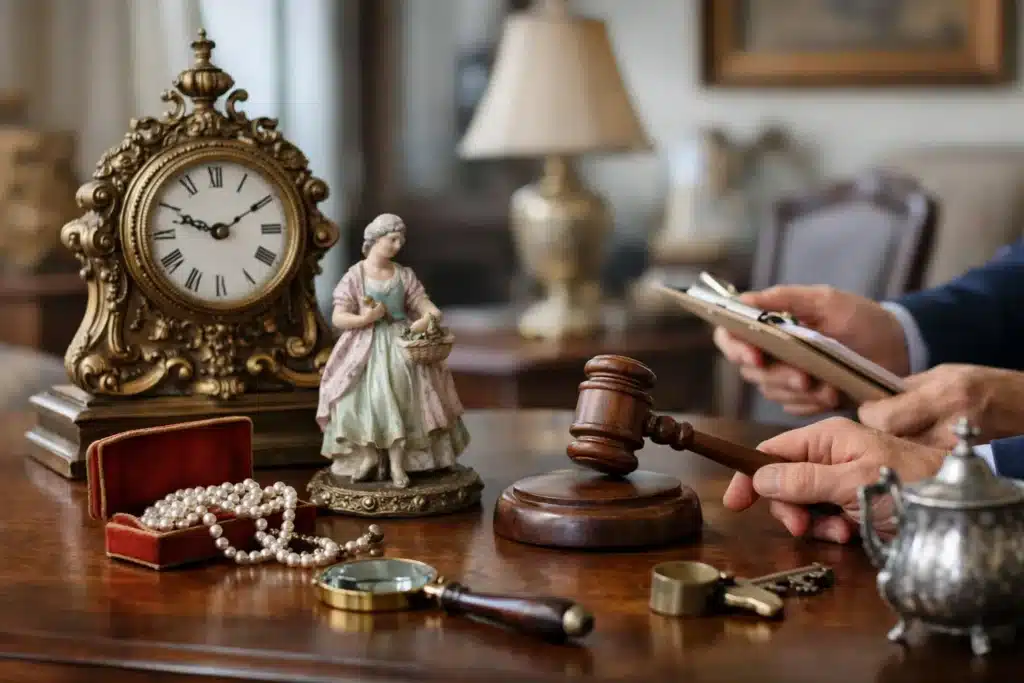
A house full of inherited property can be emotionally demanding before it becomes a practical question. A walnut chest may have been part of family life for generations, while a small box of silver, a landscape painting, or an unassuming vase may carry more market interest than expected. Knowing how to sell inherited antiques begins with slowing down long enough to identify what you have before decisions are made.
The goal is not to treat every old object as a treasure. It is to avoid discarding, donating, repairing, or selling something before its age, maker, condition, and current market are understood. A careful process also helps families, executors, trustees, and attorneys document decisions appropriately when an estate is involved.
Four Seasons Auction Gallery, headquartered in Gainesville, Georgia, assists families, executors, trustees, collectors, and estate representatives with the sale of suitable antiques, fine art, estate jewelry, sterling silver, Asian antiques, and other collectible personal property. Although based in North Georgia, we welcome auction consignment inquiries from throughout the United States and internationally.
Start with identification, not a price tag
Many inherited items are described by family stories: “Grandmother’s Victorian table,” “the good china,” or “a painting from Europe.” Those descriptions can be meaningful, but they are not enough to establish value or the best selling method. Furniture styles are often reproduced, makers’ marks can change an object’s market position, and provenance can matter greatly for fine art, Asian art, coins, jewelry, and certain collectibles.
Begin by grouping property by category. Set aside paintings and prints, furniture, sterling and silverplate, jewelry, clocks, rugs, ceramics, glass, coins, books, decorative arts, and collectibles. Keep accompanying paperwork with the relevant item, including receipts, prior appraisals, certificates, exhibition labels, correspondence, and photographs showing the object in its original setting.
Then look for details without trying to “improve” the piece. Photograph signatures, labels, stamps, hallmarks, serial numbers, maker’s plaques, and construction details. For furniture, photographs of the back, underside, drawers, hardware, and joinery are often as useful as a full view. For a painting, record the front and back, frame, signature, labels, and any inscriptions.
A prior appraisal can provide useful history, but it should not be treated as a current selling price. Markets change, and the purpose of an appraisal matters. An insurance appraisal, for example, commonly reflects replacement value, which is different from the fair market value conclusions often needed for estate planning or administration. An auction estimate is also not a formal appraisal. It is a market-based opinion of the range a property may bring at a particular sale, under particular selling conditions.
Avoid the costly instinct to clean or repair
The fastest way to reduce the appeal of an antique is sometimes an enthusiastic cleaning project. Original surfaces, patina, finishes, and signs of age can be part of an object’s value. Polishing sterling aggressively can soften detail. Refinishing period furniture can remove evidence that collectors want to see. Washing a textile, rug, painting, or paper item without proper guidance can cause permanent damage.
This does not mean inherited property should remain dusty or unsafe to handle. Basic, gentle care is sensible. Remove loose dust with a soft cloth, protect fragile objects from direct sunlight and moisture, and keep small valuables secure. But pause before using metal polish, furniture oil, glue, tape, household cleaners, or do-it-yourself repairs.
Condition does affect value, and some repairs are worthwhile. The question is whether the cost and nature of the work make sense for that particular object and its intended market. A professional review can help distinguish a repair that supports saleability from one that erases originality.
Get the right kind of evaluation
An experienced auction professional can often provide an initial opinion about what appears suitable for consignment, what may need further research, and what is unlikely to justify auction marketing. This is especially useful when a family is sorting a large household and needs a practical plan rather than isolated opinions on every item.
Some situations call for a formal personal property appraisal rather than an auction consultation. Estate tax reporting, estate administration, insurance, charitable donations, equitable distribution, and certain legal matters may require an independent opinion of value prepared for a specific intended use. Charles Pharr Jr., ISA Certified Appraiser of Personal Property (CAPP), provides professional personal property appraisal services in accordance with applicable requirements of the Uniform Standards of Professional Appraisal Practice (USPAP) and the ethical obligations of the International Society of Appraisers. Each assignment establishes the intended use, intended users, effective date, appropriate definition of value, and scope of work. Appraisal conclusions are developed independently and objectively, without regard to a desired result or potential auction consignment.
Jewelry deserves special attention. Precious-metal content, gemstones, designer attribution, condition, and current market demand can influence value. When an assignment requires specialized gemstone identification, grading, or technical examination, an appropriately qualified jewelry or gemological specialist may be needed. Four Seasons Auction Gallery can review jewelry for potential auction consignment, but an auction estimate is not automatically a formal jewelry appraisal.
Decide whether auction is the right selling method
Auction can be an effective way to sell inherited antiques because it brings property to an active market rather than relying on a single dealer’s offer. Well-cataloged property can reach regional, national, and sometimes international bidders through online bidding platforms, while local preview opportunities allow buyers to inspect items in person.
Still, auction is not automatically the best answer for every object. It depends on the category, estimated value, condition, size, urgency, and depth of buyer demand. A signed painting, a collection of sterling, a fine Persian rug, a desirable mid-century design piece, or a group of coins may benefit from targeted auction exposure. Large common furniture, heavily worn decorative items, or low-value household contents may be better handled through an estate liquidation plan, local sale, donation, or other disposition method.
The best sale strategy often involves separating a household into groups. Higher-value and specialized property may go to auction. General furnishings may be handled in an estate sale or liquidation. Family members may retain sentimental items before anything is marketed. This approach is usually more effective than forcing every object into one sale format.
What professional auction presentation adds
Selling inherited antiques is not only about placing an item online. Presentation influences whether qualified buyers notice and trust the offering. Clear photography, accurate dimensions, condition descriptions, maker identification, relevant provenance, and sensible lot groupings all affect buyer confidence.
For example, a set of sterling flatware should be described by pattern, maker, weight where appropriate, and any monograms or condition considerations. A painting needs the artist attribution stated carefully, with supporting markings and provenance identified when available. A period chest should be cataloged with its materials, construction, dimensions, condition, and any restoration disclosed. Careful wording protects both the consignor and buyer while making the property easier to find in the right market.
Four Seasons Auction Gallery markets its auctions through established online platforms, including LiveAuctioneers, Invaluable, and AuctionZip. These platforms allow prospective buyers from across the United States and internationally to discover and bid on accepted consignments. Professional cataloging, photography, and appropriate marketing help present desirable antiques and collectible property to an informed audience. Auction results depend on actual buyer participation and market conditions, and no specific selling price can be guaranteed.
Understand estimates, reserves, and proceeds
A realistic estimate is not a promise or a guarantee. It reflects available market evidence, the object’s characteristics, and the anticipated audience for a specific auction. Estimates should be discussed openly, particularly when a family has seen a similar object listed online at an unrealistic asking price.
A reserve is the confidential minimum price below which a lot will not sell, if one is agreed upon. Reserves can offer protection in appropriate cases, but they also need to be realistic. An overly high reserve can discourage bidding or leave a desirable item unsold when interested buyers are present. For many consignments, the better result comes from accurate estimates, strong presentation, and competitive bidding rather than an inflated minimum.
Before consigning, ask for a clear explanation of the seller’s commission, photography or handling charges if applicable, insurance arrangements, transportation, timing, and payment schedule. If an estate has multiple decision-makers, establish who has authority to consign and approve terms. Executors and trustees should retain relevant records, including consignment agreements, inventories, sale results, and correspondence.
Make a practical plan for the property that remains
Inherited estates rarely consist only of antiques. Once the items with auction potential have been identified, the remaining property still needs a plan. That may include household furnishings, kitchenware, clothing, tools, books, linens, and personal effects. Establishing a sequence prevents unnecessary work: family selections first, evaluation and documentation next, then consignment, liquidation, donation, or disposal as appropriate.
If there is a deadline to sell a home, communicate it early. A professional can advise whether property should be collected for an auction, marketed on site, or divided among several channels. Timing affects decisions, but it should not force a rushed judgment about the items most likely to deserve research.
Selling Inherited Antiques in Atlanta, North Georgia, and Nationwide
Four Seasons Auction Gallery, headquartered in Gainesville, Georgia, works with families, collectors, executors, trustees, attorneys, and estate representatives seeking appropriate methods for selling inherited antiques and valuable personal property.
Our auction consignment services focus on original fine art, antiques, estate jewelry, sterling silver, Asian antiques, Persian rugs, desirable furniture, and other collectible property.
We welcome suitable auction consignment inquiries from throughout the United States and internationally. Accepted consignments are professionally cataloged and marketed through LiveAuctioneers, Invaluable, and AuctionZip.
For clients requiring an independent opinion of value, Charles Pharr Jr., ISA CAPP, provides professional personal property appraisal services for estate tax reporting, insurance, charitable donations, equitable distribution, and other appropriate purposes.
Have inherited antiques, fine art, jewelry, or a collection you are considering selling?
Contact Four Seasons Auction Gallery about auction consignment
Need a professional personal property appraisal?
Learn about our appraisal services
Whether you are settling an estate or selling individual inherited pieces, the first step is identifying the property, understanding its market, and selecting the appropriate professional service.