A coin can look ordinary in a dresser drawer and still deserve careful attention. Date, mintmark, condition, metal content, variety, and provenance can each affect buyer interest. For families settling an estate, collectors refining a collection, or owners considering a sale, the decision to sell rare coins at auction should begin with identification and market placement, not a quick offer based only on bullion value.
The right auction process gives qualified buyers enough information to bid with confidence. It also helps a seller understand a central reality of the coin market: rarity alone does not set value. Demand, authenticity, preservation, certification, and the number of comparable examples available all matter.
Why sell rare coins at auction?
An auction is often a practical selling method when coins have collector appeal beyond their precious-metal content. Competitive bidding can be especially useful for better date U.S. coins, gold coins, certified examples, colonial and early American issues, world coins, commemoratives, proof sets, error coins, and well-assembled collections.
Unlike a direct purchase offer, an auction exposes property to multiple interested bidders at the same time. When a coin is properly described, photographed, and placed before the right audience, bidders can assess it for their own collections, inventory, or investment interests. That competition may establish a stronger market result than a single buyer’s offer, although results always depend on the individual coin and current demand.
Auction is not automatically the best route for every group of coins. Common-date silver coins, heavily circulated material, damaged pieces, or lots valued primarily for metal content may be more appropriately grouped and sold by weight or in larger lots. A knowledgeable review helps determine whether coins should be sold individually, in small thematic groups, or as bullion-related property.
Start with a careful review, not cleaning
One of the most costly mistakes a seller can make is cleaning coins before seeking advice. Polishing, rubbing, dipping, or using household cleaners can leave hairlines, alter surfaces, and substantially reduce collector value. Even coins that appear tarnished may have original surfaces that buyers prefer.
Keep coins in the holders, envelopes, albums, or flips where they are currently stored whenever possible. Handle raw coins only by their edges, ideally over a soft surface, and avoid adhesive tape, PVC-containing plastic holders, and improvised labels placed directly on the coin.
During an initial review, an auction professional may look at denominations, dates, mintmarks, visible condition, apparent metal, and whether coins have been certified by a recognized third-party grading service. Original albums, old coin envelopes, purchase records, and prior auction invoices can also provide useful context. They do not guarantee authenticity or value, but they can help establish provenance and guide research. Coins requiring specialized authentication, grading, or variety attribution may warrant examination by a qualified numismatist or recognized third-party grading service before being offered for auction.
What makes one coin more desirable than another?
Coin values are shaped by several overlapping factors. A coin’s date and mintmark may indicate a low mintage, but surviving population and collector demand are often more meaningful than mintage figures alone. Condition is equally important. Two coins with the same date may bring very different prices if one retains sharp detail and original luster while the other is worn, cleaned, or impaired.
Certification by recognized third-party grading services, such as Professional Coin Grading Service (PCGS) or Numismatic Guaranty Company (NGC), can provide prospective bidders with an independent professional opinion regarding a coin’s authenticity and grade. Still, a holder is not a substitute for sound cataloging. Buyers consider the grading service, the grade, the coin’s visual appeal within that grade, and recent market activity. Some coins are attractive candidates for certification; others are not, particularly when expected value does not justify the cost and time involved.
Varieties deserve attention as well. A small mintmark difference, doubled die, overdate, die variety, or error can change how a coin should be described and marketed. This is one reason broad labels such as “old coins” or “silver dollars” can leave value on the table. Careful identification gives the market a clearer reason to pay attention.
Auction estimates are market guidance, not formal appraisals
Before consigning, sellers commonly want to know what their coins may bring. An auction estimate is a good-faith opinion of an anticipated selling range based on research, condition, comparable sales, current demand, and the planned auction format. It is intended to guide the auction process, not to promise a result.
A formal appraisal involves developing an independent, impartial, and objective opinion of value for a defined intended use. Estate administration, insurance, charitable donations, equitable distribution, and other assignments may require a written appraisal report identifying the effective date, appropriate definition of value, scope of work, and supporting research and analysis. An auction estimate prepared for consignment purposes is not a substitute for a formal appraisal.
This distinction matters particularly for executors, trustees, and families managing inherited collections. The appropriate next step depends on the assignment. A collection being prepared for sale may need cataloging and auction estimates. An estate requiring a documented value as of a particular date may need a formal appraisal before any sale decisions are made.
How coins should be organized for auction
Good cataloging begins by separating coins from related material such as paper currency, medals, tokens, proof sets, mint sets, and precious-metal jewelry. These categories may appeal to different buyers and should not automatically be combined.
Within a coin collection, individual pieces may be offered separately when their dates, grades, certification, or rarity justify focused attention. More modest material can often perform better in thoughtfully assembled lots, such as a group of Morgan silver dollars, a run of proof sets, a collection of ancient coins, or a group of gold coins offered by denomination.
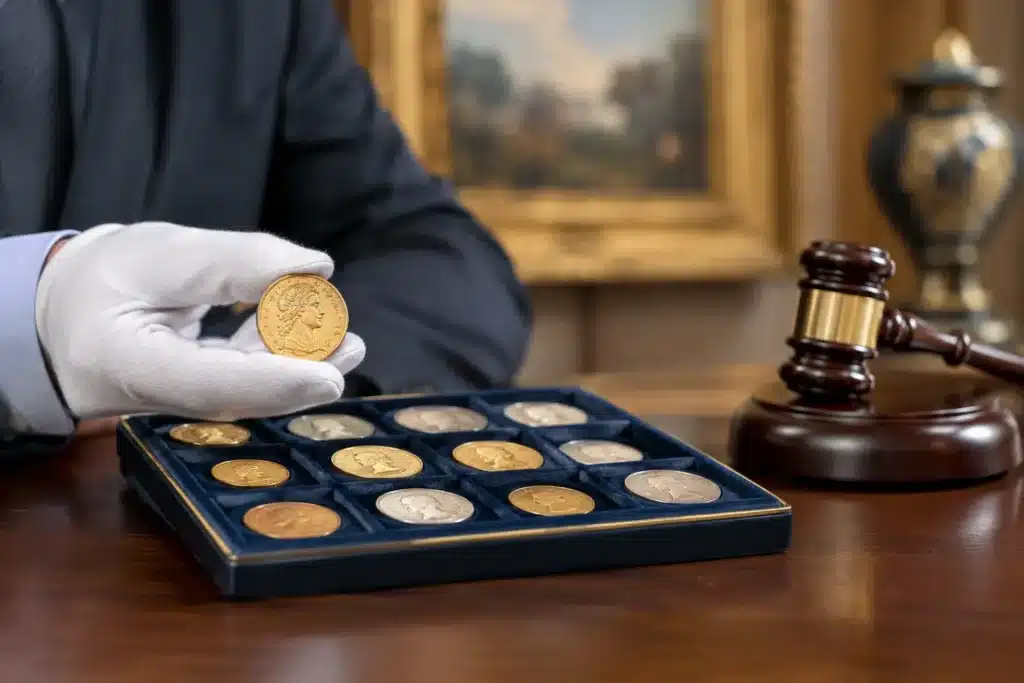
Photography is more than a formality. Clear images of both sides of a coin, certification labels where applicable, and significant details help remote bidders evaluate property before the sale. Accurate descriptions should identify relevant facts without overstating condition, rarity, or likely value. In a market where buyers may be bidding from across the country, candor builds confidence.
Reaching the right bidders matters
A local collection can have a national market. Four Seasons Auction Gallery combines hands-on evaluation and professional presentation with online exposure through LiveAuctioneers, Invaluable, and AuctionZip. This allows appropriate consignments to be seen by bidders locally, nationally, and internationally rather than relying only on foot traffic or a single local buyer.
Broad exposure is particularly valuable when a collection includes several collecting areas. One bidder may be seeking U.S. gold, another may follow world crowns, and another may be interested in medals or exonumia. A well-structured sale gives each category an opportunity to reach the people most likely to recognize its appeal.
That said, more exposure does not eliminate market variables. Coin prices can move with precious-metal markets, collector trends, grading populations, and overall economic conditions. An experienced auction house should discuss those factors plainly and recommend an approach suited to the material rather than making inflated promises.
Questions to ask before consigning coins
Before choosing an auction partner, ask how the coins will be identified, photographed, cataloged, and marketed. Ask whether significant coins will be offered individually, whether certified coins will be described by certification number when appropriate, and how reserves or minimum expectations are handled.
It is also reasonable to ask about seller commissions, insurance while property is in the auction house’s care, shipping arrangements, settlement timing, and what happens if a lot does not sell. Clear terms protect both the consignor and the auction house. They also make it easier for multiple family members, attorneys, or fiduciaries to understand the process.
For inherited collections, resist the temptation to divide coins among relatives before the collection has been reviewed. What appears to be a similar group of coins may contain one or two pieces with materially different market potential. A preliminary evaluation can help families make informed decisions before property is dispersed.
A rare coin deserves neither hype nor guesswork. Leave it as found, preserve its documentation, and have it reviewed before accepting a casual offer. Careful handling and an honest, well-presented auction process give the market the information it needs to recognize what the collection may truly be worth.